




Sheet Protectors and Binder Accessories Buying Guide
Sheet protectors look like a one-line reorder until you put two packs side by side and notice how far apart they sit on price. The gap comes down to four things: weight, load style, finish, and pack size. The right combination depends almost entirely on how often the pages inside get handled, not on how important the documents are.
This guide walks through how to choose the best sheet protectors for real office use, and it covers the binder accessories that belong in the same order. It is written for office managers, school administrators, facilities staff, and procurement teams who want to standardize on fewer items and stop deciding again every time the supply closet runs low.
Start by browsing our full selection of bulk clear sheet protectors to see what is available in the sizes and weights covered below.
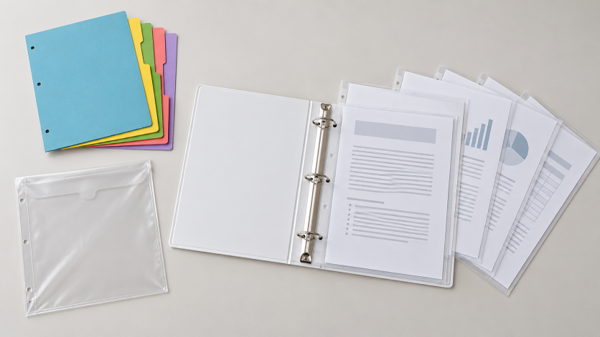
What are sheet protectors and what do they do?
A sheet protector is a clear plastic sleeve, pre-punched for a three-ring binder, that holds a printed page and shields it from tearing, creasing, fingerprints, and spills. Pages slide in and out, so you can reuse the same sleeve as documents are updated.
That reusability is the operational argument. In binders that get revised on a schedule, such as price lists, safety data sheets, or training modules, you replace the paper and keep the sleeve. Pages that would otherwise get punched, torn out of the rings, and reprinted stay intact through repeated handling.
Which sheet protector weight do you need?
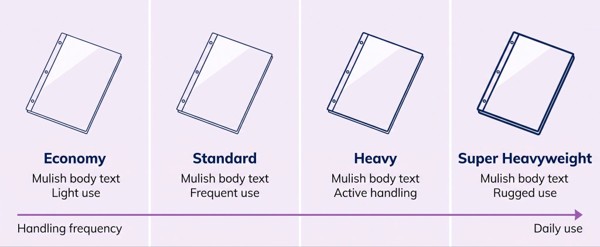
Weight is the single decision that drives cost the most, and it is where most offices over-buy or under-buy. Manufacturers label sheet protectors across four broad tiers: economy, standard, heavy, and super heavyweight. Heavy-duty sheet protectors have a thicker film, resist curling, and hold their shape when you pull them repeatedly from the rings.
The practical rule is to match weight to handling frequency, not to document importance. A signed contract that sits in an archive binder and gets opened twice a year does not need heavy-duty sheet protectors. A shift checklist that a dozen people touch every day does.
Weight
|
Handling Level |
Typical Use |
|
Economy |
Rarely opened |
Archive binders, reference copies, and single-season use |
|
Standard |
Weekly or occasional |
SOP binders, training manuals, and meeting materials |
|
Heavy |
Several times a week |
Price lists, spec sheets, and inspection checklists |
|
Super Heavyweight |
Daily or rough conditions |
Route sheets, shop floor postings, and warehouse binders |
If you are buying for a whole facility, a good approach is to stock two weights rather than four. One standard weight covers general office filing, and one heavy weight covers everything handled frequently. Two SKUs are far easier to reorder and far harder to get wrong.
Should you buy top-loading or side-loading sheet protectors?
Load style is about how the page goes in, and it matters more than it sounds when you are assembling binders in volume.
- Top-loading. The opening runs along the short edge. This is the fastest option for building binders at scale, since pages drop straight in. It is the standard choice for most office applications.
- Side-loading. The opening runs along the long edge, next to the rings. Pages are less likely to slide out when you store a binder upright on a shelf or carry it sideways.
- Multi-page capacity. Wider gussets hold several sheets in one sleeve, which helps when you want to consolidate a thick appendix without adding bulk to the rings.
- Secure-top designs. A flap or overlapping edge closes the opening. Worth the upgrade for binders that travel between sites.
What is the difference between clear and non-glare sheet protectors?
Clear sheet protectors are fully transparent and show color accurately, which makes them the right pick for photos, product images, marketing sheets, and anything where color fidelity matters.
Non-glare sheet protectors have a lightly frosted surface that diffuses reflected light. In a conference room with overhead fluorescents, or on a page posted at eye level in a warehouse, a clear sleeve throws back enough glare to make text hard to read at an angle. Non-glare sheet protectors solve that. The trade-off is a slight loss of sharpness, so avoid it for detailed images.
Choose based on lighting conditions and reading angle. Bright overhead light or a page read standing up points to non-glare. A page read flat on a desk, or one carrying color graphics, points to clarity.
Which sheet protectors are best for archival storage?
Two materials dominate the category. Polypropylene is the common choice for document storage, including recycled polypropylene options. Vinyl sleeves are also widely available and tend to feel softer and more flexible.
For records you need to keep for years, including HR files, compliance documentation, permits, and legal records, look specifically for sleeves labeled acid-free or archival sheet protectors. Those designations are what indicate a material intended for long-term contact with paper. If a product page doesn't say it, don't assume it.
For everything else, material is secondary to weight and load style. Most office binders hold working documents and don't necessarily need archival sheet protectors.
What sizes do sheet protectors come in?
Letter size is the default, but it is not the only option. Here is an overview of sheet protector sizes:
- Letter (8.5 x 11). The standard for virtually all office binders.
- Legal (8.5 x 14). Contracts, legal filings, and long-form forms.
- Ledger (11 x 17). Spreadsheets, schematics, floor plans, and production schedules. Requires a matching ledger binder.
- Mini (5.5 x 8.5). Half-size binders, field guides, and compact reference sets.
The mistake to avoid is sizing to the document, not the binder. An 11 x 17 sheet folded into a letter sleeve creates a page nobody wants to open. Confirm the binder format first, then order matching sleeves in the appropriate sheet protector sizes. Our guide to 3-ring binders covers how binder capacity and ring style affect what fits.
Which binder accessories are worth stocking?
Finding the best sheet protectors solves only one problem. A binder that people actually use needs a few more things, and buying them in the same order saves a second requisition later.
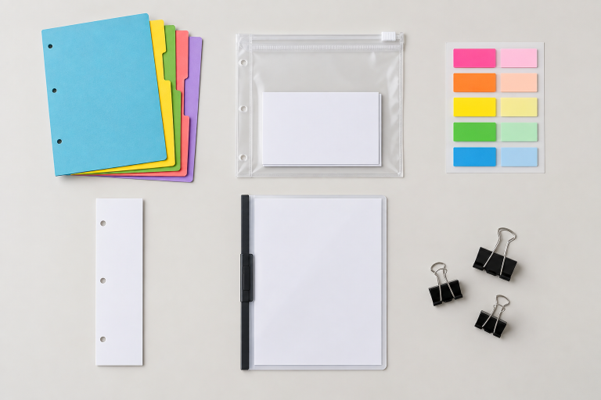
Here's a look at common binder accessories that you may need:
-
Index dividers. The highest-value accessory in the list. In any binder with more than a handful of sections, tabbed dividers are what turn a stack of pages into something searchable. Printable and pre-printed options work, and printable is more flexible for sections that change.
-
Binder pockets and sleeves. For anything that should not be hole-punched: loose forms, business cards, receipts, and warranty cards. Zippered versions keep small items from migrating.
-
File inserts and index tabs. Self-adhesive and repositionable tabs let you mark pages within a section without adding a full divider.
-
Report covers. For documents that go out the door rather than into a binder. Clip-style and pressboard covers present a short document cleanly without adding rings.
-
Binder clips. The right answer for temporary page sets is not to punch them at all.
How do you buy sheet protectors in bulk without over-ordering?
Bulk pricing only pays off if the pack size matches consumption. Three steps make that estimate reliable:
-
Count the pages, not the binders. 10 binders at 40 protected pages each is 400 sleeves, not 10 packs. Add a reasonable margin for replacements.
-
Compare cost per sleeve, not price per box. Pack quantities vary widely across the category, so box price tells you very little on its own. Divide it out before comparing.
-
Standardize before you scale. Settling on two weights and one size across the organization means larger quantities of fewer items, which is where volume pricing actually helps.
Sheet protectors are a small line item that quietly determines whether a binder holds up for a year or falls apart in a month. Match the weight to how often pages get handled, pick a finish that suits the room, and order the dividers, pockets, and tabs in the same pass so the binder is usable the day it is built.
OnTimeSupplies.com carries a full range of the best sheet protectors in bulk quantities, from economy sleeves for archive binders to heavy-duty sheet protectors for daily-use documents, along with the index dividers, binder pockets, report covers, and 3-ring binders that go with them. Purchase order ordering and GSA pricing are available so that you can process a full binder refresh as a single requisition instead of several small orders.
Which sheet protector should you buy for your use case?
Use Case |
Recommended Specification |
|
SOP or training binder, handled weekly |
Standard weight, top-load, letter |
|
Shop floor or warehouse posting |
Super heavyweight, non-glare, letter |
|
Price list or spec sheet, daily use |
Heavyweight, top-load, letter |
|
Archive or compliance records |
Archival or acid-free, standard weight |
| Reusable worksheet sleeves for schools |
Heavyweight, top-load, letter |
| Binder that travels between sites |
Secure-top or side-load, heavyweight |
Common Questions About Binder Accessories
What are the different types of sheet protectors?
They are grouped by weight (economy through super heavyweight), load style (top-load, side-load, multi-page, and secure-top), finish (clear or non-glare), and size (letter, legal, ledger, and mini).
What is the difference between clear and non-glare sheet protectors?
Non-glare sheet protectors have a frosted surface that cuts reflected light, which helps under overhead lighting. Clear ones are fully transparent and better for photos and color graphics.
What sheet protector is best for archival storage?
Look for products specifically labeled as acid-free or archival sheet protectors. Those designations indicate a material intended for long-term contact with paper.
What sheet protector weight should I buy for daily handling?
Heavy or super heavyweight. Thicker film resists curling and tearing when you repeatedly pull pages from the rings.
Do sheet protectors fit all 3-ring binders?
Standard letter-size protectors fit standard three-ring binders. Legal, ledger, and mini sizes need a binder in the matching format.
Sign Up For Updates!
Posts by Category
Questions & Answers

Subscribe for Updates on Deals & Promotions
- We are: