




Office Supply Procurement Guide for Smart Bulk Buying

Bulk buying office supplies should be one of the easiest ways to control spend, yet for most teams it happens in fits and starts. Someone notices the copy paper is gone, places a rush order, and pays a premium for the privilege. This guide replaces that scramble with a repeatable procurement process: a step-by-step system for deciding what to stock, how much to order, where to buy it, and how to keep it organized. Done well, bulk buying stops being a guessing game and becomes a predictable, cost-saving routine.
It's written for the people who actually own this work: office managers, operations leads, and procurement specialists at small and mid-sized companies. With hybrid schedules making demand less predictable and supply costs still elevated, a disciplined approach matters more than ever. The good news is that procurement discipline and productivity go hand in hand. When the right wholesale office supplies are always on hand at the right price, no one wastes time chasing stockouts or untangling supplier chaos.
Why Bulk Office Supply Procurement Needs a Strategy
Buying in bulk without a plan can quietly cost you more than buying as you go. Ad-hoc ordering means paying higher per-unit prices, absorbing rush shipping fees, and burning staff hours on repetitive small orders spread across too many vendors. Every unplanned reorder is a small tax on both your budget and your team's attention.
Buying in bulk without a plan can quietly cost you more than buying as you go. Ad-hoc ordering means paying higher per-unit prices, absorbing rush shipping fees, and burning staff hours on repetitive small orders spread across too many vendors. Every unplanned reorder is a small tax on both your budget and your team's attention.
Overbuying carries its own risks. Cash gets tied up in inventory you won't touch for a year, shelf-life-sensitive items expire before they're used, and a cluttered supply room makes it harder to see what you actually have. The goal isn't to buy as much as possible. It's to buy the right quantities of the right items at the right time.
A structured approach flips the equation in your favor. When purchasing is driven by real usage data such as consumption history, seasonality, and demand forecasts, you gain budget predictability, stronger negotiating power, and cleaner vendor relationships. That's the foundation of best-practice bulk buying, and the reason companies that consolidate vendors and cut shipping fees consistently spend less. The rest of this guide walks through how to build that discipline:
- Audit consumption and forecast demand before you commit
- Decide what belongs in bulk, and what doesn't
- Set up storage and stock controls that keep inventory usable
- Source and compare suppliers on total value, not just price
- Budget, price, and time purchases to maximize savings
- Standardize policies so the system runs without you
Step 1: Audit Current Inventory and Forecast Demand

Before you buy anything in volume, you need to know what your office actually consumes. Start with a 30-day baseline audit. Record what's on hand today, then track everything that leaves the supply closet for a month. This short window is enough to reveal true consumption patterns without turning into a data project you'll abandon.
As the numbers come in, sort items into three buckets that will drive every later decision:
- High-volume, steady use: items you burn through predictably, like copy and printer paper, pens, and file folders.
- Low-volume or occasional: things you replace rarely, like staplers and paper punches or scissors.
- Short shelf-life or performance-sensitive: ink and toner, batteries, adhesives, and breakroom snacks that degrade or expire.
Watch for usage spikes before you buy office supplies in bulk. Hiring waves, quarterly reporting periods, audits, and client-facing events all pull extra supplies. Note when those happen so a single busy month doesn't distort your averages or leave you short.
You don't need forecasting software for office supply procurement. A simple approach works for most offices: take your 30-day consumption, multiply out to a quarter, then adjust up for any known seasonal spikes. That gives you a realistic demand estimate to carry into the next step, where you'll decide which of these items are worth buying in bulk.
Step 2: Decide What to Buy in Bulk vs What to Buy Sparingly
Your audit points directly at the answer. The best bulk candidates share three traits: high volume, low variability, and a long shelf life. Copy paper, pens, manila and hanging file folders, and most janitorial cleaning products fit the profile perfectly. You'll use every unit, prices per item drop sharply at volume, and nothing goes to waste sitting on a shelf.
Some items should rarely be bulk-purchased. Durable, low-turnover equipment like staplers, tape dispensers, and scissors lasts for years, so a case of them ties up cash and space. Buy these in the small quantities you genuinely need and move on.
A middle category calls for restraint rather than avoidance. Adhesives dry out, batteries lose charge in storage, and breakroom perishables have hard expiration dates. Buy these in modest quantities timed to real consumption, and rotate stock so the oldest gets used first. The savings from over-ordering rarely survive the waste.
Finally, turn these decisions into a living "bulk-eligible" list tied to specific SKUs, so reordering is a simple lookup rather than a fresh judgment call each time. Revisit the list whenever the office changes. New headcount, a different printer fleet, or a shift in work model can move an item from one category to another overnight.
Step 3: Plan Storage, Space, and Stock Controls
Bulk savings evaporate if you can't store what you buy. Start by mapping your real storage capacity, including shelf footage, closet volume, and any overflow space, and let those limits cap your order quantities. Ordering 40 cases of paper into a closet that holds only 10 creates clutter and increases the risk of damage.
- Centralize the supply station. A single, organized supply room beats supplies scattered across desk drawers and "hoards." Centralizing makes stock visible, reordering accurate, and shrinkage easier to spot.
- Use FIFO (first in, first out). Shelve older stock in front so it gets used first. This is essential for batteries, adhesives, coffee and snacks, and cleaning products that lose performance or expire.
- Label clearly and shelve by category. Group paper, filing, writing, and breakroom items into zones so anyone can find and restock them in seconds.
- Add light access controls. A simple sign-out sheet or a designated person who manages the closet prevents supplies from walking off and keeps counts honest.
Physical organization isn't busywork. It directly reduces reorders and saves time. When stock is visible and rotated, you order less often, waste less, and never discover a dead battery or a dried-out marker at the worst possible moment. The idea of a dedicated supply coordinator starts here; the policies that formalize the role come later.
Step 4: Source, Compare, and Select Suppliers
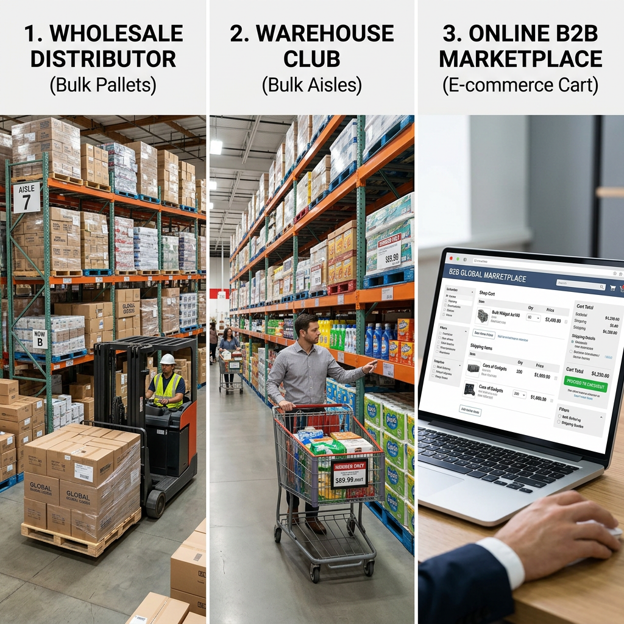
A resilient supply chain rarely runs on a single vendor. Most offices are best served by a small mix drawn from three supplier types, each suited to a different job:
- Wholesale distributors (e.g., Grainger, Quill-style office specialists): deep catalogs, business pricing, and account terms, ideal for recurring core supplies.
- Warehouse clubs (Costco, Sam's Club, BJ's Wholesale Club): strong per-unit prices on high-volume commodities, but limited SKUs and less flexibility.
- B2B online marketplaces (Amazon Business): breadth and speed for flexible, smaller batches and hard-to-find items
Price is only the starting point. Compare suppliers by total value, weighing the factors below before you commit to bulk-buying office supplies.
| Factor | Wholesale distributor | Warehouse club | B2B marketplace |
|---|---|---|---|
|
Price at volume |
Low with contract pricing |
Lowest on commodities |
Variable |
|
Minimum order qty |
Flexible |
High |
Low |
|
Shipping/delivery |
Freight, often free over threshold |
In-store or delivery |
Fast, membership-based |
|
Return policy |
Business-friendly |
Generous |
Varies by seller |
|
Payment terms |
Net 30 / Net 60 available |
Card/membership |
Business account terms |
|
Sustainability options |
Often certified eco lines |
Limited |
Depends on seller |
|
Product authenticity |
High |
High |
Verify third-party sellers |
Wherever possible, set up a corporate or B2B account. These unlock Net 30 or Net 60 payment terms, loyalty rewards, and contract pricing that ad-hoc buyers never see. Then consolidate. Name a primary supplier for the bulk of your recurring orders and a backup for gaps and price checks. That balance captures volume savings while protecting you against stockouts, price spikes, or delays from a single vendor.
Step 5: Budgeting, Pricing, and Timing Your Bulk Buys
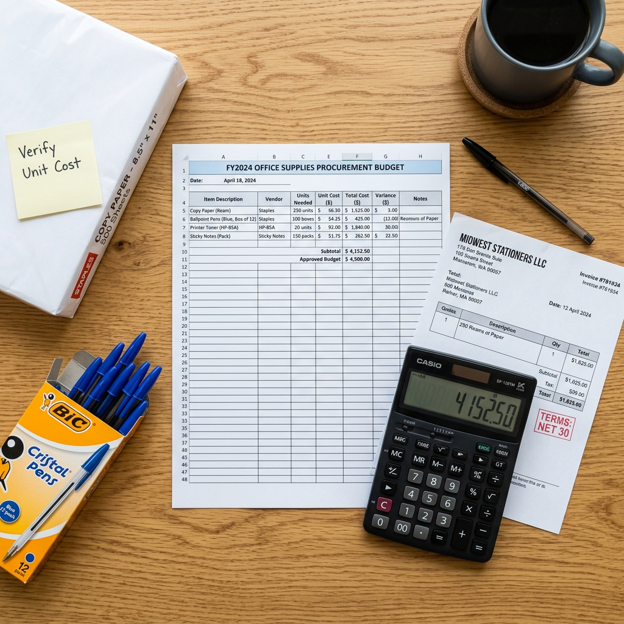
Real cost lives at the unit level, not the sticker. Always calculate the true cost per item by dividing the total order (including freight, handling, and any account fees) by the number of usable units. A "cheaper" case that arrives with high freight can easily cost more per ream than a modestly priced one with free delivery.
Build a simple category-level budget from your Step 1 data. Assign an annual or quarterly spend target to paper, writing supplies, filing, janitorial, and breakroom, tied to your forecasted usage. Category budgets make overspending visible early and give you a baseline to negotiate against.
Freight and fragmented ordering quietly inflate total spend. Consolidating purchases into fewer, larger orders, and choosing suppliers whose delivery terms offset any volume discount, often saves more than chasing the lowest headline price.
Time your buys to the calendar. Back-to-school windows and year-end clearance routinely deliver the deepest discounts on core supplies, and stocking up on steady, long-shelf-life items can then lock in a year of savings. Layer in payment terms strategically. Net 30 and Net 60 terms improve cash flow by allowing you to use supplies before the invoice comes due, while volume discounts lower the unit cost outright.
Finally, test generic or store brands on true commodities such as basic paper, utility pens, and cleaning refills, where quality differences are negligible. Protect brand-name spend for mission-critical items like printer-matched toner, where a cheap substitute can cost more in failures than it saves.
Step 6: Standardize Policies, Reordering, and Employee Use
A good process shouldn't depend on any one person's memory. Formalize it so wholesale office supplies run the same way every week:
- Standardize SKUs. Pick one preferred option per common item, such as one house pen, one copy paper, and one notebook, so you buy at volume and simplify reordering.
- Assign an inventory gatekeeper. Give one supply coordinator ownership of counts, orders, and the supply room. Clear accountability prevents both stockouts and duplicate ordering.
- Set minimum and reorder points. Define a trigger level for each key item. For example, reorder paper when stock drops to 5 reams, so you replenish on schedule rather than panic-buying.
- Add an approval workflow for exceptions. Route special or non-standard requests through a quick sign-off so one-off purchases don't quietly balloon the budget.
- Communicate responsible use. Frame guidelines around shared savings, not restriction. A brief note on where supplies live and how to request them encourages good habits without feeling like rationing.
Sequenced this way, the policy becomes an internal playbook that any team can follow, and that keeps working even when the office manager is out.
Bulk Office Supply Order Checklist
Before placing any bulk order, run through a quick pre-purchase check. It takes two minutes and catches the mistakes that turn a "deal" into wasted money or a cluttered closet.
Keep this checklist where you order from. Screenshot it, print it, or drop it into your internal SOP so the same review works for paper, cleaning supplies, and breakroom goods alike.
|
|
|
|
|
|
|
|
|
|
|
|
|
|
|
|
|
|
|
|
|
Putting Your Bulk Office Supply Plan Into Action
You don't have to roll this out all at once. Start with a single pilot category to buy office supplies in bulk. Paper and writing tools are ideal because usage is steady and savings are easy to see. Run the full process on that one category for a quarter, then expand to filing, janitorial, and breakroom once it's working.
Measure as you go. Track a few simple metrics such as spend per employee, number of rush orders, and stockout incidents, so you can prove the plan is working and spot where it isn't. Sit down quarterly with finance and key stakeholders to review those numbers and refine reorder points, budgets, and supplier terms. Revisit your suppliers, contracts, and standardized SKUs at least once a year, since headcount, equipment, and work models all shift over time.
Incremental progress beats waiting for a perfect system. Pick one category, schedule time this week to run your first 30-day inventory audit, and let the data guide your next order. Browse bulk office supplies to see current pricing and start building your standardized list today.
|
|
Frequently Asked Questions
What office supplies should I buy in bulk, and which should I avoid?
Buy high-volume, low-variability, long-shelf-life items in bulk, such as copy paper, pens, file folders, and cleaning products. Purchase sensitive goods like adhesives, batteries, and breakroom perishables sparingly, and avoid bulk-buying low-turnover tools like staplers and scissors.
Which suppliers and purchasing terms are best for bulk office supplies?
Build a primary-and-backup mix across wholesale distributors, warehouse clubs, and B2B online marketplaces. Compare total value, not just price, including lead times, return policies, sustainability, and product authenticity. Use corporate accounts with Net 30 or Net 60 terms and loyalty or contract pricing to lower total cost.
When should I time and budget my bulk office supply purchases to save the most?
Set an annual or quarterly budget tied to historical usage, calculate the true unit cost including freight, and time purchases around back-to-school and year-end clearance while using volume discounts and Net 30/60 terms to optimize cash flow.
How much inventory should I keep on hand?
Base it on your 30-day consumption audit projected over a quarter, plus a small buffer for known spikes such as hiring waves or reporting periods. Set reorder points so you replenish before running out without overstocking.
Are generic or store-brand office supplies worth it for bulk buying?
Yes for true commodities such as basic paper, utility pens, and cleaning refills, where quality differences are minimal. Protect brand-name spend for mission-critical items like printer-matched toner, where a failed substitute can cost more than it saves.
Sign Up For Updates!
Posts by Category
Questions & Answers

Subscribe for Updates on Deals & Promotions
- We are: