




Bulk Mailing Supplies Buying Guide
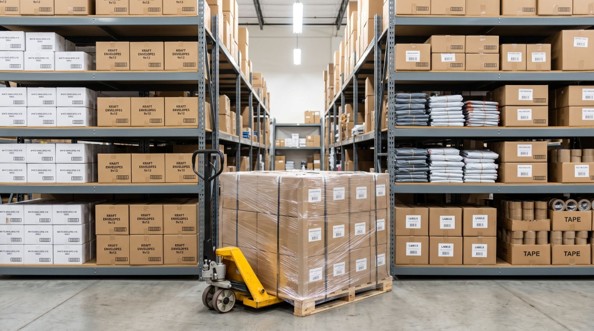
When you buy bulk mailing supplies for an organization, one wrong spec gets repeated in every box on the pallet. The wrong envelope sizes, a closure your team doesn't want, or a label that jams the office printers turn into returns, delays, and a second order.
This guide is for buyers who order by the case or pallet: purchasing and facilities managers, school and government buyers, and resellers. It covers the formats most organizations standardize on, how to compare cost per unit, how to forecast volume across sites, and how to store bulk stock so it's still usable when you open it.
Quick Answer: The Core Bulk Mailing Supply List
Most organizations standardize on these seven formats:
-
-
#10 business envelopes, the highest-volume item for invoices, statements, and letters
-
9 x 12 and 10 x 13 clasp or catalog envelopes for flat documents
-
Poly, bubble, or Tyvek mailers for lightweight shipments
-
Mailing and shipping labels in bulk packs
-
Packaging tape in multi-roll packs, plus dispensers for each packing station
-
Interoffice envelopes for internal routing between departments and sites
-
Coin and small-parts envelopes for cash handling, keys, and parts
-
Every format above is available in business envelopes and mailing supplies.
Standardize Formats Before You Scale Orders
The fastest way to lower mailing costs across an organization is to cut the number of SKUs. Ten departments each ordering their own envelope style means ten small orders at a higher per-unit cost. Buying bulk mailing supplies is often worth it, because with one approved list, you can buy larger quantities of fewer items.
-
Pick one #10 standard covering closure, window, and security tint, and use it for all general correspondence.
-
Pick one flat-document standard, either 9 x 12 catalog for outgoing mail or clasp for internal files.
-
Match labels to your printers. Confirm that evsite'ste’s printers can run the label you choose before you buy it for everyone.
-
Keep specialty items on a short list so you don't end up with dozens of one-off SKUs.
Resellers should apply the same logic in reverse. Stock the formats end customers already recognize, and keep the core envelope sizes in stock every time.
Envelope Size Chart: Formats to Standardize On
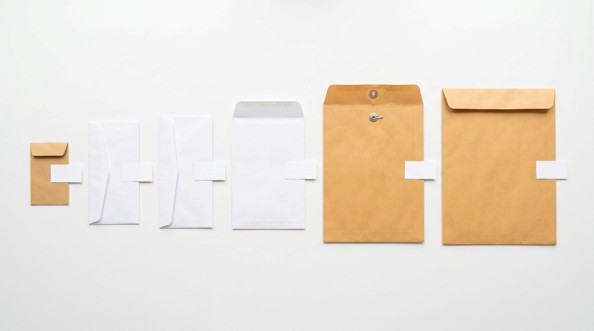
Envelope sizes use a number or letter code instead of a measurement, and that is where bulk envelope ordering mistakes start. Confirm the dimensions before you approve a large order.
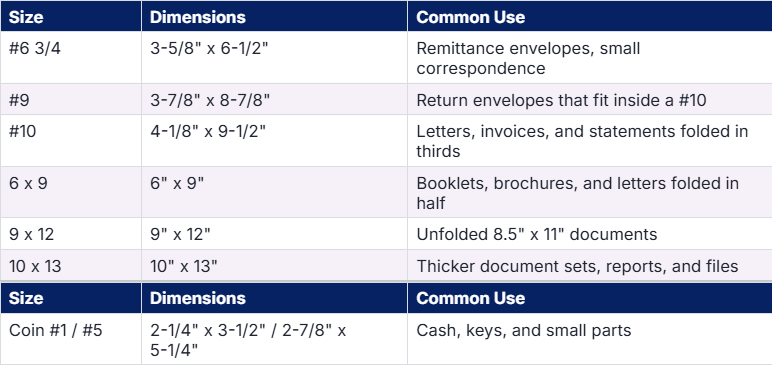
What size of bulk envelopes fits 8.5" x 11" paper? Use a #10 envelope for pages folded in thirds. Use a 9 x 12 envelope to mail them flat, or a 10 x 13 envelope for thicker sets.
Are all #10 envelopes the same size? Yes. A standard #10 measures 4-1/8" x 9-1/2". The closure, paper weight, window, and security tint vary, so include all four in your approved spec.
Check USPS rules before volume mailings. USPS sorts mail into letters, flats, and parcels by size and thickness, and those categories affect postage. Clasps, strings, and rigid contents can make letter-size mail nonmachinable. Check current requirements on USPS Postal Explorer before approving a pallet of one format.
Business Bulk Envelopes (#10): Your Highest-Volume SKU
#10s move faster than any other mailing item, so small spec choices add up across a year of orders.
-
Closure. Gummed flaps cost the least but need to be moistened. Peel-and-seal closes without water and saves labor on high-volume runs.
-
Window. Window envelopes use the address printed on the document, so billing records don't need labels. Confirm your invoice template matches the window before you buy in bulk.
-
Security tint. Standardize on tinted envelopes for payroll, billing, tax, and HR mail.
-
Pack size. Compare cost per envelope across 100-count boxes, 500-count boxes, and multi-box cartons, not the price per box.
For high-volume mail rooms, the Universal Peel Seal Strip #10 Business Envelope, 500/Box is a practical standard. It is self-adhesive, white, and measures 4.13" x 9.5". A 100-count, security-tinted version with the same closure is ideal for confidential mail.
Security Bulk Envelopes: Set a Policy, Then Stock It
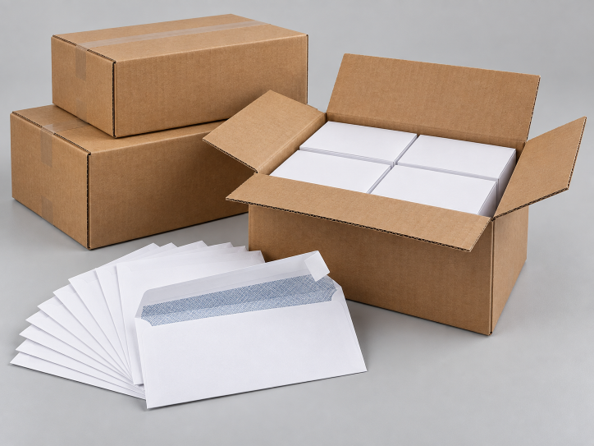
Security envelopes come in two types, and your policy should say which mail needs which one.
-
Security tint envelopes use a printed interior pattern that blocks the contents from view. This is the standard for payroll, bank, tax, benefits, and billing mail.
-
Tamper-evident envelopes and mailers show visible signs if someone opens them. Use them for legal, high-value, or chain-of-custody materials.
Most organizations need security tint #10s in volume and tamper-evident stock only in smaller quantities.
Clasp vs. Catalog Envelopes
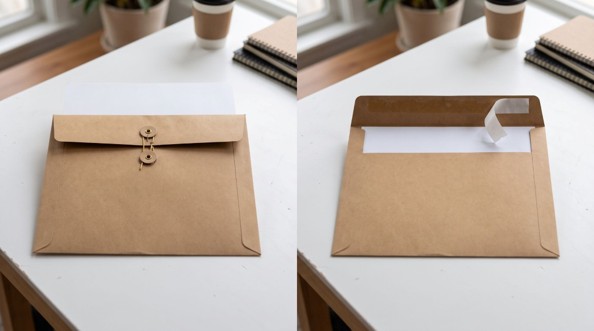
Both formats hold flat 8.5" x 11" documents. Choose one based on whether the envelope goes out in the mail or stays in internal circulation.
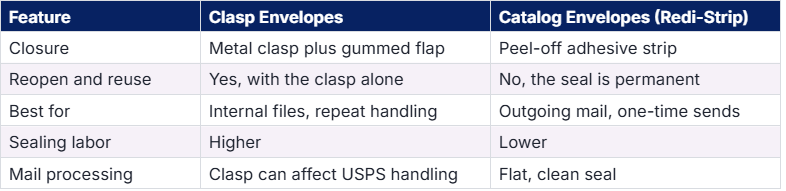
For outgoing document mail, the Quality Park Redi-Strip Catalog Envelope, #10 1/2, 9 x 12, Brown Kraft, 100/Box is one of the site's top-selling mailing items. For internal files, standardize on a 9 x 12 kraft clasp envelope, and add 10 x 13 for thicker document sets. A 28 lb kraft stock holds up better under heavy contents, which means fewer torn envelopes and resends.
Poly vs. Bubble vs. Tyvek Mailers
For organizations that ship product, or resellers stocking mailers for customers, the choice comes down to protection, weight, and cost per shipment.
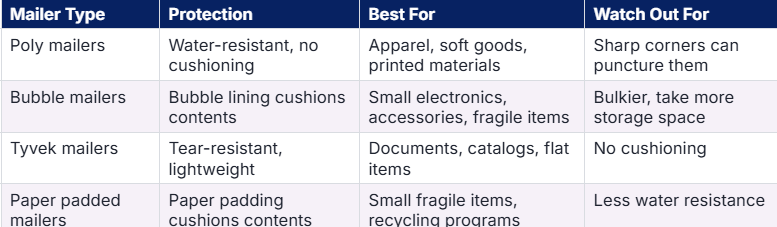
Are bubble mailers or poly mailers better? It depends on what you ship. Poly mailers are lighter and pack flatter, so a case takes up less storage space. Bubble mailers cost more per unit but reduce damage to breakable items.
Do poly mailers rip easily? They resist tearing, but hard or pointed items can puncture them. Stock bubble mailers or boxes for those items.
Specialty and Interoffice Envelopes
-
Interoffice envelopes. Reusable clear 10 x 13 poly inter-department envelopes with string closures hold up through many trips. Stock a supply at each department or site.
-
Coin and small-parts envelopes. #1 envelopes in 250-count boxes and #5 envelopes in 500-count boxes cover cash rooms, key control, and maintenance parts.
-
Clear plastic envelopes and mailing tubes. These are low-volume specialty items, such as 4 x 9 heavy-duty clear envelopes and 48" x 4" tubes for plans and posters.
Mailing and Shipping Labels
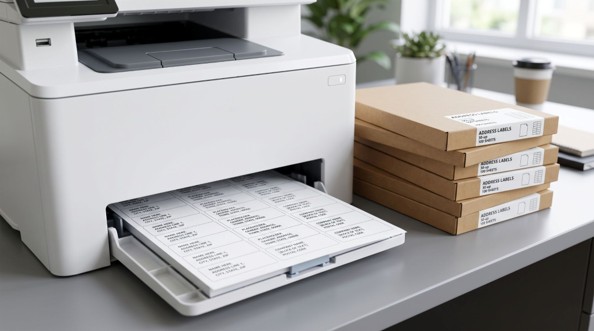
Before you buy labels for more than one site, confirm printer compatibility. Sending an inkjet-only label to laser printers across an organization is an expensive mistake.
-
Format. A 30-per-sheet layout at 1" x 2-5/8" is a common address format with wide template support.
-
Material. White labels work for general mail, clear labels for colored stock, and weatherproof labels for packages.
-
Volume. Bulk packs, such as 1,500-label packs and 100-sheet boxes, lower the cost per label.
Compare mailing label options and give each site the Universal and Avery label template guide so every location prints the same way.
Packaging Tape and Packing Station Supplies
-
Width. Tape just under 2" wide (1.88") is the standard for most shipping boxes.
-
Core fit. Standardize on one dispenser model per packing station and buy tape with a core that fits it.
-
Multi-roll packs. High-volume stations should buy tape in multi-roll packs.
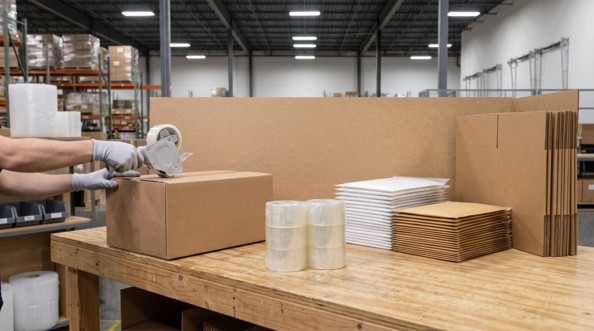
The Scotch 3850 Heavy-Duty Packaging Tape with Dispenser (1.88" x 54.6 yd, 3" core) works as a starter unit for each new packing station. Refill those stations from multi-roll packs. Adhesive-backed mailing seals, sold in rolls of 5,000, close booklets and self-mailers without tape.
How to Plan Case and Pallet Orders
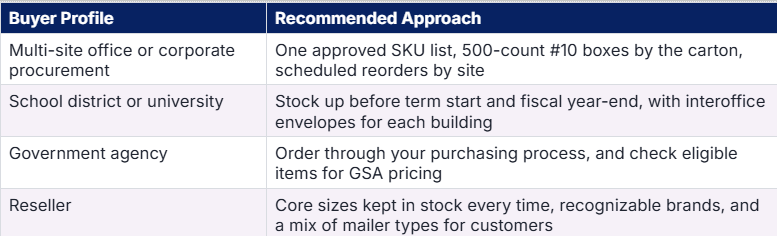
The cheapest way to buy bulk mailing supplies is to combine standardized formats, larger pack sizes, and a regular reorder schedule. Use this process:
-
-
Pull 3 to 12 months of usage by SKU and by site. Use invoice history if you have no inventory system.
-
Convert to cost per unit. Compare box, carton, and multi-carton pricing for each approved format.
-
Map demand peaks. Billing cycles, fiscal year-end, tax season, open enrollment, and school start all raise volume.
-
Set reorder points that cover usage until the next order arrives, plus a buffer for peak periods.
-
Consolidate by order. Combine envelopes, labels, mailers, and tape to fill cases and reduce shipments.
-
Check storage space. A pallet only saves money if you have a cool, dry place to keep it.
-
Storage tip: Keep envelope cartons flat and off the floor in a cool, dry area. Heat and humidity can cause gummed flaps to stick shut and weaken peel-and-seal adhesive. Rotate stock so older cartons go out first.
Government buyers: see government purchasing for agency ordering options.
Restock at Scale
Standardize your formats, compare by cost per unit, and order on a schedule tied to real usage. That keeps every site stocked through peak periods without tying up extra budget or storage space.
Order by the case: go to envelopes and mailing supplies, or browse packing and shipping supplies for tape, boxes, and packaging materials.
Need help with a bulk order? Contact the OnTimeSupplies.com team. You'll reach real people who can match specs across sites, build case and pallet quotes, set up net terms, and handle anything else your procurement process requires.
Frequently Asked Questions
What is the cheapest way to buy bulk mailing supplies?
Standardize on a short list of formats, compare cost per unit across box and carton sizes, and consolidate orders on a regular schedule. Fewer SKUs let you buy larger quantities of each.
What are the most common envelope sizes for businesses?
The #10 (4-1/8" x 9-1/2") is the most common business envelope. Organizations also stock #9 return envelopes, 9 x 12 and 10 x 13 envelopes for flat documents, and 6 x 9 envelopes for booklets.
How should bulk envelopes be stored?
Store cartons flat, off the floor, in a cool, dry area. Heat and humidity can seal gummed flaps and weaken adhesive strips. Rotate stock so older cartons are used first.
Are bubble mailers or poly mailers better for bulk shipping?
Poly mailers are lighter, pack flatter, and cost less per unit, which works well for soft goods. Bubble mailers cost more but protect items that could break or scratch.
Should I buy 100-count or 500-count envelope boxes?
Buy 500-count boxes, or cartons of them, for formats you use every day to lower cost per unit. Use 100-count boxes for low-volume or specialty formats.
Sign Up For Updates!
Posts by Category
Questions & Answers

Subscribe for Updates on Deals & Promotions
- We are: